Wear It Like You Mean It
Style as Self-Expression, Not Approval
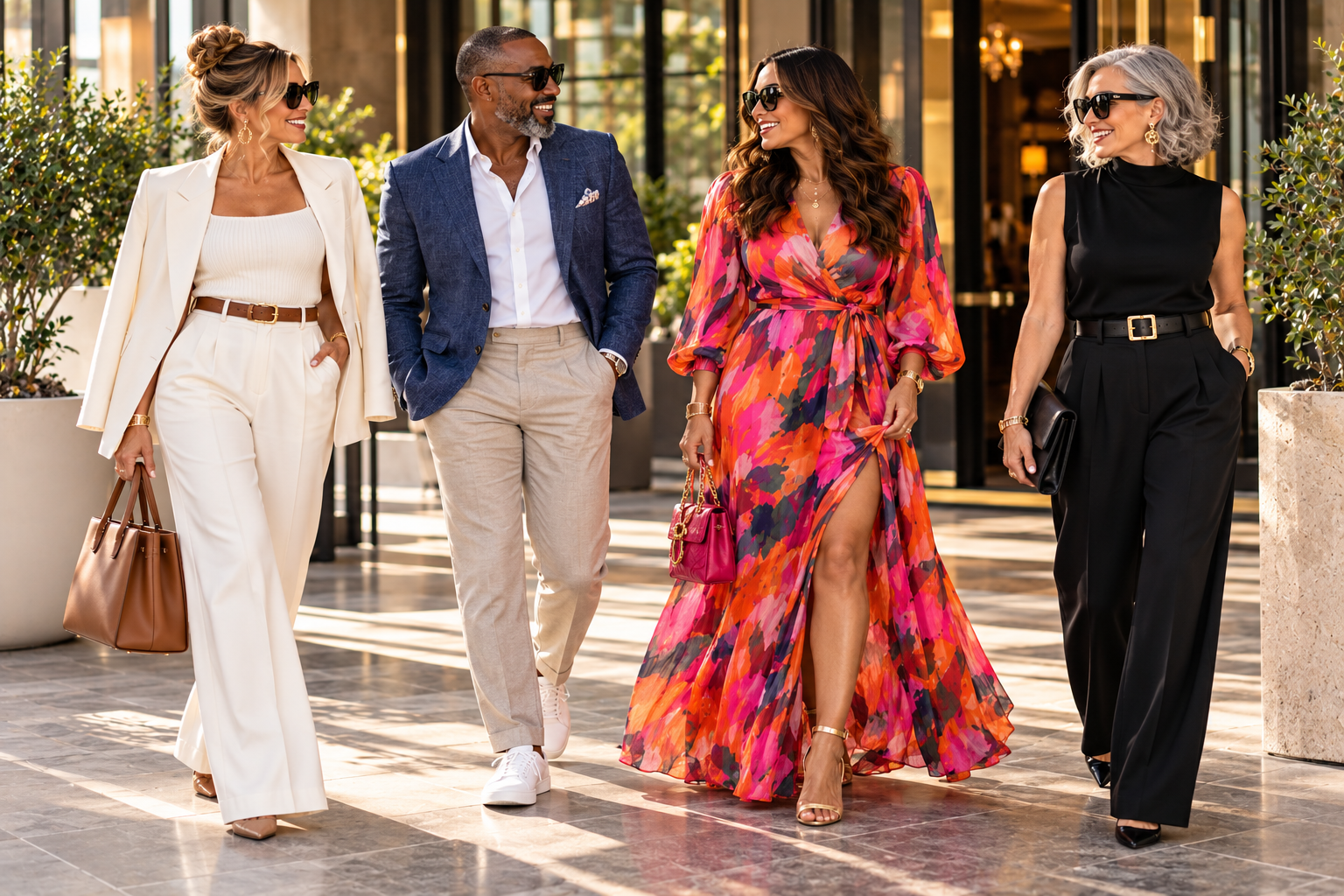
At some point, getting dressed became unnecessarily complicated.
What should be a fairly simple question - What do I want to wear today? - can turn into an entire committee meeting in your head.
Is this too young for me? Too fitted? Too bright? Is that still in style? Can I wear this at my age? Does this make me look bigger? Smaller? Taller? Shorter? Am I overdressed? Underdressed? Trying too hard?
And somewhere underneath all those questions is often the one we don’t say out loud:
What will people think?
Personal style gets a lot more interesting when that question stops running the show.
Who Made All These Rules Anyway?
Fashion has always come with rules.
Some are practical. A black-tie invitation probably isn’t the moment to test your favorite sweats, and what works for brunch may not work for a board meeting. Understanding the setting and dressing appropriately is simply part of knowing how to navigate different spaces.
Other rules are far more questionable.
Women over a certain age shouldn’t wear short skirts. Men of a certain age shouldn’t wear sneakers with suits. Certain body types shouldn’t wear stripes. Someone decided sequins belong at night, white belongs between Memorial Day and Labor Day, and apparently entire colors can become unavailable depending on your complexion.
That is a lot of authority to give people who aren’t standing in your closet.
Somewhere along the way, many of us learned to dress according to what was supposedly “flattering,” “appropriate” or “age-appropriate” without ever stopping to ask whether we actually liked the result.
There is a difference between understanding style and surrendering to rules.
Your Body Is Not a Problem Your Clothes Need to Solve
Spend enough time reading fashion advice and you may start to believe the primary purpose of clothing is optical illusion.
Hide this. Minimize that. Create the appearance of a smaller waist. Make the legs look longer. Distract from the arms. Draw attention away from the stomach.
Apparently, we’re all just one strategically placed belt away from fooling everyone.
There is nothing wrong with understanding proportion or choosing silhouettes that make you feel good. Clothing can absolutely highlight the parts of yourself you love.
The problem comes when getting dressed becomes entirely about correcting your body.
Your wardrobe should do more than make you appear smaller.
It can make you feel interesting. Sophisticated. Sexy. Relaxed. Creative. Powerful. Playful. Elegant. Maybe even a little ridiculous every once in a while, because fashion is allowed to be fun.
Not every outfit needs to perform a magic trick.
Style Should Change Because You Do
Personal style isn’t supposed to remain frozen at whatever age you first figured out what looked good on you.
Lives change. Bodies change. Careers change. Priorities change. Eventually, the closet usually needs to catch up.
Maybe you spent years wearing corporate clothes and now work in an environment where a suit feels unnecessarily formal. Perhaps you once loved heels and now wonder why anyone voluntarily spends six hours with their feet at that angle. The person who once lived in neutrals may suddenly discover she loves red.
Evolution doesn’t mean you’ve lost your style.
It means you’re paying attention.
Getting older can actually make personal style better because experience has a way of eliminating some of the performance. After enough years of buying things because they looked great on someone else, you start recognizing what deserves space in your own closet.
That knowledge is valuable.
Trends Are Suggestions, Not Assignments
Every season brings a new list of things we are apparently supposed to buy.
One year everything is oversized. The next year it’s fitted. Jeans get wider, then narrower, then wider again. A color that was considered dated suddenly becomes the color everyone needs immediately.
Fashion is funny like that.
Following trends can be enjoyable. They introduce new ideas and occasionally convince us to try something we would never have considered otherwise.
But participation is optional.
Being stylish doesn’t require replacing your wardrobe every time the internet declares something “out.” Neither does having personal style mean refusing to wear anything popular just to prove you’re original.
Try the trend.
If you love it, keep it.
If you look in the mirror and wonder what temporary lapse in judgment brought you here, take it off.
No committee meeting required.
There Is Confidence in Repeating Yourself
One of the strangest modern fashion pressures is the idea that we should constantly appear in something new.
Social media certainly hasn’t helped. When every dinner, vacation and event has the potential to become a photograph, repeating an outfit can somehow feel like a failure of imagination.
Meanwhile, some of the most stylish people are recognizable precisely because they repeat themselves.
They know their colors. Their silhouettes. Their accessories. They understand what works for their lifestyle and return to it again and again.
That isn’t boring.
It’s personal style.
A closet filled with clothes you genuinely enjoy wearing is far more useful than one packed with options that looked exciting on the hanger but never quite feel like you.
Dress for the Person in the Mirror
There will always be opinions.
Someone will think the color is too bright. Another person won’t understand the shoes. Your friend may love an outfit you hate, while the piece that makes you feel incredible gets nothing more than a polite, “Oh, that’s different.”
Fine.
Style is communication, but you still get to decide what you’re trying to say.
That doesn’t mean ignoring every piece of feedback or pretending presentation doesn’t matter. How we show up affects how people perceive us, and different environments come with different expectations.
The distinction is whether those expectations inform your choices or completely control them.
You can dress appropriately for the room without disappearing inside it.
The best wardrobe isn’t necessarily the most expensive, the trendiest or the one filled with pieces everyone else admires. It’s the one that makes sense for the life you actually live and gives you enough freedom to express the person living it.
So wear the color.
Repeat the outfit.
Skip the trend.
Try the one you swore you never would.
Keep the heels if you love them, and leave them at home if you don’t.
Personal style becomes much simpler once you stop dressing for an imaginary audience.
Look in the mirror instead.
Does this feel like me?
If the answer is yes, wear it like you mean it.